Creating Your Trademark:
What to do and what not to do...
Remember that your Trademark is an indication of the source of goods or services
It is not the name or description of a specific thing, as such, nor is it necessarily the same as your company name.
Be sure to use your mark correctly!
It is very important that a mark be used correctly, so that the mark's character is preserved. This is sometimes stated as "a trademark is an adjective, not a noun or verb."
That is, to use several famous examples:
- Always use the generic description of the goods in combination with the mark: You can listen to your iPod® media player or surf the web on your iPad® tablet, you eat an Oreo® cookie or wear Nike® athletic shoes. Don't talk about putting on your Nikes with your iPod in your pocket while you eat Oreos and play a game on your iPad.
- Never use the mark as a verb: You can "copy" something on a Xerox® copier, you cannot "xerox" it. Don't "Google" something - do a search on the Google search engine.
- Never use the mark as a plural or possessive: If you sell Portoflan® armatures, don't say something like "Bliveplex Portoflan armatures are the best Portoflans in the world!" in your advertising. Kids play with Lego® bricks, not legos; you eat Hershey® chocolate bars, not Hersheys.
- Capitalize the mark, as appropriate: Xerox, Craftsman, Kodak.
- Use the word "brand" if necessary to clarify the status of your mark: One uses a "Kleenex® Brand Facial Tissue", not "a kleenex", and seals packages with "Scotch® brand adhesive tape" not "scotch tape".
- Give proper notice: Put a trademark symbol next to the mark when it is used (the r-in-a-circle symbol ® for federally registered trademarks, superscript TM TM or SM SM for unregistered marks). Be sure to put the symbol next to the mark and not next to the generic description - for example, they're "Blivet® wing nuts", not "Blivet wing nuts®".
It isn't really necessary to clutter up every piece of text with the symbol every single time the mark is used - you just need to give "adequate notice" that you consider the word, phrase, etc., to be your mark. Certainly the symbol should be used the first time a mark is used in a document or label, and occasionally thereafter.
Some manufacturers put a note on each label or document listing all of the marks on the label or document, and noting the trademark ownership ("Scotch® and Magic Tape® are Registered Trademarks of 3M Corporation"). On a website, many companies with large portfolios of trademarks will have a separate page which lists all of the marks - for example, see Google's "Our Trademarks" page.
By the way, the Owl logo on these web pages, and the phrase "Our knowledge protects yours" are registered service marks of Brown & Michaels, PC.
Never let your mark become "generic"
A generic mark is not really a trademark, but is simply the only way to refer to a product. Becoming generic is one possible result of using your mark incorrectly. You cannot stop your competitors from talking about their products by pre-empting the name of the product. Thus, if a mark is not used correctly, so that it becomes the name of the product rather than the source of it, there is a risk of the mark being declared "generic". Otis lost the trademark "escalator" for that reason, because they advertised "the latest in elevator and escalator design", and a court ruled that if they themselves used the mark generically, so why shouldn't their competitors?
Many manufacturers who find that their brands are becoming generic (or fear that they might be), will run corrective advertising reminding the public not to use their trademarks incorrectly. For example, Xerox Corporation ran magazine ads with the headline, "Not even Xerox can make a xerox" or "Here are a list of photocopiers you can't make a xerox on..." (followed by a list of photocopier brands, including Xerox® copiers).
Companies should also try to take positive steps if they find others using their marks in a generic way. Often a simple e-mail will get a reference on a website corrected. Google has a program (with varying degrees of success) challenging publications which use or define google as a verb or talk about googling something.
Some examples of marks which started out as trademarks, but have become generic (at least in the USA) are:
- "yo-yo" - originally a trademark of the Duncan company for "return tops"
- "aspirin" - Bayer's trademark for "acetylsalicylic acid" (and still a registered mark in many countries, especially in Europe) (Believe it or not, "heroin" was also a Bayer trademark at one point)
- "escalator" - Otis Elevator Company's mark for "moving stairs"
- "zipper" - owned by B.F. Goodrich for "slide fasteners"
- "thermos" - belonged to the Thermos Company for "vacuum flasks" (they still own registrations of "Thermos" for other products such as coolers, etc.)
- "brassiere" for "ladies' support garment"
- "kerosene" - owned by Abraham Gesner for the petroleum distillate (known as "paraffin" in the UK)
Be sure to use your mark consistently!
When you decide on a mark, you should also decide how you want to present the mark - and then do it consistently from the very beginning. If you are not consistent in your use of the mark, you are weakening the mark because you are lessening the likelihood that consumers will recognize the mark and associate it with your products. You will probably want to set up at least a brief written style sheet to guide your employees and contractors in the right way to display your mark.
Some of the things to consider:
-
Capitalization: While it is true that typography doesn't matter if you are looking at "likelihood of confusion" for infringement purposes, it is important to be consistent in typography if you are trying to establish a mark, so that people will recognize your mark as your mark. That is, if you are going to use "camel case" for the mark (i.e., with the "hump" in the middle - iPad, eBay, etc.) then be consistent and always use the mark that way.
-
Punctuation: Is the mark one word, or more than one word? Are you going to use a dash between the parts, a space, an apostrophe? Decide on one way to punctuate the mark, and use it consistently - if the mark will be Supra PlotzTM, then use it that way. Don't also use Supraplotz, Supra-Plotz, Supra'Plotz, etc.
-
Generic term: Decide what the generic term for your product is, and use it consistently. If your product is a PortoflanTM
 grease fitting, then make sure that "grease fitting" is the phrase you always use.
 -
Location: Where are you going to physically put the mark on your product? On your website? On your advertising? Again, consistency counts, since the consistent location of the mark in itself serves to identify your product. On web pages, it's traditional to put logos or other marks in the upper left-hand corner of the page as well.
Pop quiz: where did Nabisco put their logo on their boxes? Right - in a triangle in the upper left-hand corner of the front of the box. Even if you couldn't see the logo clearly at a distance, the red triangle in the corner of the box identified the source of the biscuits. -
Color: Even if color isn't part of the mark as such, be consistent in what color(s) you use when you use color. It's OK to put your mark in color on the box or label, but use it in ordinary black and white type in spec sheets and other documents which are reproduced in black and white. However, don't put the mark in blue on some boxes and red on others and green on the website and yellow in the ads. Pick one, and use it consistently. One exception to this could be if you establish families of products and use color to distinguish the families - for example, if you sell labels and all labels with removable adhesive have blue labels and all those with permanent adhesive have red labels - but that's consistent use, too.
 If you use someone else's trademark be sure to acknowledge their rights.
That is, if you talk about "Teflon®", be sure there's a disclaimer somewhere that "Teflon is a registered trademark of DuPont."
The "BIC man" character at right is a registered trademark of Bic Corporation.
Before you begin to use a mark, choose it carefully and be sure you're not infringing on someone else's mark.
A trademark search is a basic first step for anyone considering adopting a new trademark or service mark. With today's computerized databases, a trademark search is relatively inexpensive and fast, and cheap insurance against having to change your mark or defend a lawsuit later. We recommend that you start by doing a preliminary search yourself. Then, when you've settled on a mark you think is OK, confirm it by having a professional search done.
See our Trademark Budget Estimator for our fees for trademark searching. If you have a trademark search done by a service, be sure it includes Federal and State Registered Marks, at a minimum, and an opinion on the results.
You should not stop with registered marks, either - check out the World-Wide Web search engines and yellow-pages listing to find anyone using the mark who has not (yet) registered. You wouldn't want to spend a fortune adopting and promoting a mark nationwide, only to find out that a competitor has prior use rights.
The test of a mark is "likelihood of confusion" - that is, is the proposed mark so close to an existing mark that it is likely to confuse the intended consumer as to the source of the goods? If there is any question, play it safe and try another mark (or consider contacting the prior user and getting his OK, if you really want to use a mark which might be a problem).
Choose the "strongest" mark possible.
Marks vary in strength over a spectrum from a coined or invented mark, which can be very strong, through generic marks, which are not really trademarks at all. The stronger a mark is, the broader the protection it is afforded.
- Coined or Fanciful Marks are those which have no meaning, outside of the mark itself. "Kodak" or "Xerox" are good examples. Neither had any meaning in any language before they were invented to describe new products.
- Arbitrary marks use ordinary words, but the words are not associated with the product. For example, "Shell" for petroleum products, "Wishbone" for salad dressing, "Amazon" for a bookseller, "Apple" for computers.
- Suggestive marks are less broadly protected, since the words in the mark are associated with the product. They become stronger through use, as the mark acquires distinctiveness. "Rent-a-Wreck" for auto renting services is suggestive.
- Descriptive marks convey an immediate idea of ingredients, qualities or characteristics of the goods or services. "Very Best" might be a descriptive mark. "Chapstick" is descriptive, as it immediately suggests a stick for chapping. If the mark functions to identify the source of the goods, either when adopted or through use, it may be registrable, but is afforded less protection than coined, arbitrary, or suggestive marks. The division between suggestive and descriptive marks is not always easy to spot.
- Generic marks, as noted above, are not registrable and convey no rights at all.

It's been our experience that most people choose marks which are very weak and, in general, forgettable. Marketing departments dearly love generic marks, and can't understand why we would advise against "Raspberry Beer" as a mark for beer made with raspberries (yuck!). "Michael Shea's Irish Amber" (an actual trademark of the Genessee Brewing Co.) is much more distinctive and memorable than "Pretty Good Beer" would be.
There are lots of sources for good marks - look in an encyclopedia or dictionary, or to mythology or geography or history, for words whose connotations are positive and appropriate to your product. "Midas" implies wealth (for mufflers? Must be a connection somewhere), "Hercules" for strength (registered for rope since 1870, among 198 other things), "Mercury" for speed (FTD florist symbol or boat motors), the Rock of Gibraltar for permanence (used by Prudential Insurance), "George Washington" for honesty (broth, apples, many others), "Obsession" for emotional appeal (a perfume brand), and so on.
Coined marks can be very strong and valuable, and you can make them sound as if they mean something when they do not. Consider "Häagen-Dazs" ice cream (an all-American product made in New Jersey, but sounds ever so Scandinavian), or the Oldsmobile "Achieva" or Compaq "Presario" (sounds elegantly European, but are meaningless), or "Exxon" gasoline (a purely coined mark slightly reminiscent of their former "Esso" mark, and without the "S.O." [Standard Oil] derivation).
If you are planning for a line of products, consider choosing a mark which lends itself to becoming a "family" of marks. For example, Kodak has a wide variety of marks beginning with "Kod", as in "Kodell" for fabrics, "Kodalux" for processing, "Kodachrome" for film, and so on.
Avoid these Marks!
Some marks, otherwise valid, are either prohibited by law or convey no rights. These marks should be avoided:
- Geographic origin or primarily a surname: For example, "Ithaca" for maps of the City of Ithaca, or for T-shirts with the name "Ithaca" on them made and sold in Ithaca, New York. On the other hand, there are "Ithaca® shotguns" (which are no longer made in Ithaca, New York, by the way), which is a perfectly acceptable (and quite famous) trademark. The test is whether or not the purchaser is buying the product because of the geographic connotation (California Wine or those t-shirts as souvenirs of a visit to beautiful Ithaca, New York) or because the mark is associated with the product (Ithaca shotguns). Beware of using a geographic location in a misleading way - "California's Best Wine" for wine made in New Jersey, for example.
- Scandalous or disparaging marks: obscenities, racial or ethnic epithets, etc. Pardon us for not providing examples on this family
 -friendly web page...
 - Insignia of a government agency, or of certain organizations protected by law. For example, the insignia or name of the FBI, the Boy Scouts (BSA) or Girl Scouts (GSUSA), DAR, VFW, Little League, Olympics, etc., are all protected by various federal laws.
- Flags or National or State Insignia: Section 2(b) of the trademark act prohibits registration of a mark which "Consists of or comprises the flag or coat of arms or other insignia of the United States, or of any State or municipality, or of any foreign nation, or any simulation thereof." Stylized flags might be acceptable if (a) the flag design is used to form a letter, number, or design; (b) The flag is substantially obscured by words or designs; (c) The design is not in a shape normally seen in flags; (d) The flag design appears in a color different from that normally used in the national flag; or (e) A significant feature is missing or changed.
- Identifies a living individual or deceased president during the life of his widow without consent. Note that many states have "rights of publicity" and privacy laws which would also affect the choice of an individual's name, even if deceased. If you file to register a mark which appears to be someone's name, you may be required to state that no such person exists (for example, there never was a "Betty Crocker"), that the person is long dead (i.e. "Ethan Allen" for furniture) or to supply a written permission from the person named (Roy Rogers, no doubt, had to give permission for use of his name in connection with fast food).
There seems to be a segment of the population which thinks it's a good idea to run to the Trademark Office and apply to register the names of recently-famous (or notorious) people as trademarks, presumably in hopes of cashing in on someone else's fame. Don't bother - the USPTO has a policy of watching for such applications and quickly rejecting them out of hand. For example, the birth of baby "Blue Ivy Carter" to singers Beyonce and Jay-Z in early 2012 led to a spate of applications to register the baby's name for a range of products. All such applications were rejected within days. - "Famous" marks. Normally, marks are protected in the area of commerce in which they have been used. Thus, it is possible for there to be 200 registrations for "Hercules" used on a wide variety of goods from soap and rope to computer graphics. Some marks are so inherently famous, however, that any use of the mark or anything like it is a problem, even if the famous owner has not and never will enter your field. You can expect to receive a nasty letter from Rochester if you announce your new "Kodak Dog Food", and forget that "Xerox House Paint".
- "Clever" Misspellings of Otherwise Unusable Marks. No, you can't use "Koke", "Polaroyd", "Z-Rocks" or "Codac". They are too close to the famous marks. A descriptive mark like "speedy" for a fast car is not registrable if you write it "spee-d". Similarly, if "Broccoli" is generic for broccoli, then so is "Brokoli".
- Marks using elements which are protected under other laws. For example, don't even think of using Mickey Mouse as your logo, even if he (and his ears, alone, for that matter) weren't a registered trademark of the Disney company. Drawings of Mickey and friends are protected under copyright.
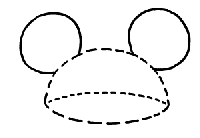
Mouse ears are a registered trademark of Walt Disney Company
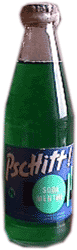 Watch out for pitfalls...
- Foreign Words should be evaluated in terms of their English meanings. The popular "Pschitt soda" from France (a Perrier brand), or "Bimbo" doughnuts from Mexico are unlikely to make it big under those names in English-speaking countries. "Barberskum" is a Scandinavian word for shaving cream which probably would not be good choice in the US, and the Japanese "Asse" candy or "B-M" coffee are not a good bet for import, either.
- English words should be checked as to their meaning in foreign languages, if international marketing is contemplated. Some Coca Cola bottlers found out that the Chinese characters they chose to represent the sounds "Coca Cola" meant "bite the wax tadpole" - not a connotation they would have chosen. Eventually they changed to characters which sounded the same, but meant "happiness in the mouth." Clairol's "Mist Stick" fell flat in Germany - where "mist" is slang for "manure".
You might have heard the story about the Chevy Nova, too. According to the story, General Motors discovered too late that "No va" means "it doesn't go" in Spanish, so they couldn't sell cars until they changed the name. Unfortunately, it isn't true - see the Snopes Urban Legends page. GM knew what "no va" meant, but assumed (correctly) that any Spanish speaker would recognize the difference between the ungrammatical "no va" and the brand "Nova". As a matter of fact, the Nova sold quite well in Latin America, and the name never was changed. Makes a good story, though, doesn't it?
- Consider Regional Variations in English, too: Even other English-speaking countries might have problems with marks which are innocuous in American English - while you can easily sell a "fanny pack" in American stores to American boys, British boys would find the suggestion laughable (they don't have "fannies", only girls do, and in front, not behind...). Most English speakers (other than Americans) would pronounce the letter "Z" as zed, while Americans use zee, so any mark depending on either pronunciation would fall flat in the other region (the many American "E-Z" product names just don't have the same connotation when pronounced "ee-zed"). In reverse, we've been approached by a number of foreign clients over the years who wanted to register English words which were innocuous in their countries, but had unsavory or offensive connotations here.
Registering Your Mark
Marks which are in use in interstate or foreign commerce (i.e. are sold over state lines, or between the U.S. and foreign countries) may be registered in the U.S. Patent and Trademark Office. Such registration conveys a number of advantages, not the least of them being actual nationwide notice to possible infringers. Registration allows the trademark owner to use the (r) symbol, to sue in federal courts, to recover damages, profits and costs from an infringer, and conveys a presumption of validity to the ownership and right to use the mark. After 5 years of registered use, the mark may, upon application, be declared incontestable. Federal registration also allows you to file for registration in other countries.
You may apply for a trademark registration either before or after you use the mark, but a registration will not be issued until the mark is actually used. The registration is effective for 10 years, but may be renewed over and over for so long as the mark continues to be used. See our "Questions and Answers on Trademarks" for more information on registration.