Brown & Michaels
How do I read a USPTO Filing Receipt?
Your first communication from the USPTO after filing a patent application will probably be the Official Filing Receipt. Although it might appear that this is just a formality, it really is important to review all of the information on your filing receipt carefully. For one thing, it is much easier to correct mistakes at this stage than after the patent issues, and there might be deadlines which would make it impossible or very costly if things are missed now. Also, the filing receipt will give you some useful information about your application.
Here is an example of a filing receipt, for an application which has been published as US2009-0174413 (so that none of this is confidential). The paragraph numbers below refer to the reference numbers in red.
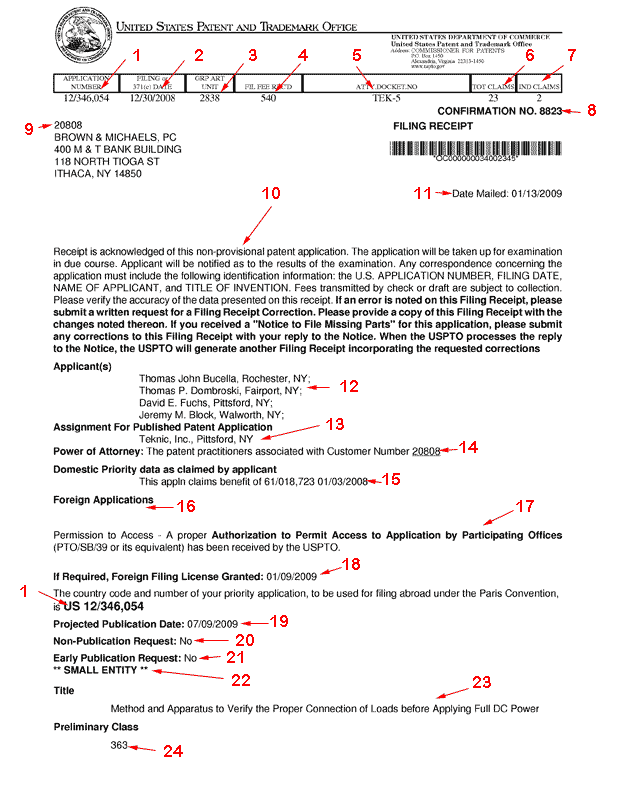
1- Application Number: Your application has been assigned this serial number. From now on, any communication with the patent office will require this number. The complete application number includes a two-digit series number (series 12 was in use from 2008 through 2010) followed by a slash, and then a six digit serial number. The serial numbers repeat from series to series, so you need the full number to identify the application.
2- Filing Date: This is the official filing date for the application. Make sure this agrees with your records - if you filed the application electronically, this is the actual date you submitted the electronic files. If you filed correctly by Express Mail, this date should be the date that the application was received by the US Postal Service. If you filed by regular mail or any non-governmental express service, the filing date will be the date the application was actually received in the USPTO mail room. If there was some problem, this field might be blank - that means you forgot to file something required and you did not yet get a filing date. You need to get this fixed, ASAP!
3- Group Art Unit: The Examiners in the Patent Office are organized into "Technology Centers", which cover broad ranges of technologies, and the Technology Centers are further divided into "Art Units". Each Art Unit handles a specific type of invention, as defined by the USPTO's classification system. In this case, our Examiner will be in Art Unit 2838 ("Power Supplies"), which is a part of Technology Center 2800 ("Semiconductors, Electrical Circuits, Static Memory, and Digital Logic") .
4- Filing Fee Received: The amount of money the USPTO received on filing this application. This will not include fees for recording an assignment, if the application was filed with one.
5- Atty Docket: If the application was filed by a patent attorney, there will usually be an internal tracking number ("docket") assigned by the law firm for ease of reference. That docket number will appear here. The USPTO will just take this information from the transmittal form or Application Data Sheet (ADS) filed with the application.
6-7- Total Claims/Independent Claims: The filing fee was based on the number of claims, and the number of independent claims. Again, make sure that this agrees with what you thought you filed. For more information on claims, see our web page "How to read a patent application - the claims".
8- Confirmation Number: This is an additional number which the USPTO uses to make sure that any papers filed later on are assigned to the right file. Be sure to keep track of this number, because it will be required on any paperwork you file in the USPTO from now on.
9- This is the correspondence address - any USPTO mailings concerning the application will be sent to this address. The five-digit number above the address is the "Customer Number" - most law firms, and some large corporations, will have these numbers, which allow a number of attorneys and a single address to be associated with their firm. Then, when a change is made to the customer number it will affect all of the firm's or company's cases at the same time. The customer number can also be used to access the USPTO "Private PAIR" system, allowing a firm to track the status of all their cases. Although it is possible for an individual to get a customer number, it is not required or commonly done.
10- Form paragraph with instructions on how to make changes. Note the "nonprovisional" - be sure that the type of application is correctly reported in this line. If you thought you filed a provisional application, or nonprovisional, the filing receipt must acknowledge the kind of application you thought you filed.
11- Date Mailed: Just that - the date the USPTO put this filing receipt in the mail. Filing receipts often take four months or more to be mailed, especially if the application was filed on paper.
12- Applicant(s): Before September 16, 2012, the terms "applicant" and "inventor" were synonymous in the US. Therefore, in filing receipts for applications filed before that date (as this one was), the "applicant" field would list the name and residence (city, state) of all of the inventors. For applications filed after September 16, 2012, if the application was assigned to a company, and the company name was listed in the Application Data Sheet as "applicant", then the company name will be listed on the filing receipt in this spot. Otherwise, the "applicant(s)" and inventors are the same, and the inventor(s) will be listed here and also as inventors.
Inventor(s): For applications filed after September 16, 2012, there will be a separate listing of inventor(s) in addition to the "applicant(s)". Make sure this list is correct - if any inventors are missing, or there are any typos, be sure to make a correction now.
13- Assignment for Published Patent Application - the application will be published 18 months after its priority date (assuming you didn't request non-publication, see 20, below). If you provided information on an assignment in the Application Data Sheet (ADS) when the application was filed, it will appear here. Note that just filing an assignment will not cause the assignee's name to appear on the published application or on the finished patent - the USPTO expects you to tell them if you want an assignee name to be published, by listing it on the ADS (for published applications) and on the issue fee transmittal (for patents).
14- Power of Attorney - Only those given a power of attorney are allowed to correspond with the USPTO about the application or to file papers. If you listed an attorney or firm or customer number in the declaration/power of attorney, or in the ADS, that information will appear here. In this case, the assignee gave us power of attorney, so our customer number appears.
15- Domestic Applications for which Priority is claimed: If this application is claiming the benefit of an earlier application, for example if this is a utility application based on an earlier provisional application (as it is here), or if it is a continuation, CIP or divisional application, the earlier application must be listed here. If it is not, get it corrected immediately, because if the priority claim is missed now you might be unable to claim priority later, or you will be subject to a very large fee for filing a late priority claim.
16- Foreign Applications for which priority is claimed: Same as 14, except that this deals with claims of priority to an earlier filed application in another country. Again, make sure this is correct and correct it immediately if it is not. Since there was no earlier foreign filing, this space is blank in the example.
17- Permission to access - you have the option to grant permission for certain foreign patent offices to access the USPTO files. If you give permission, this saves time and expense by allowing the foreign offices to get copies of your patent application directly from the USPTO instead of your having to buy a certified copy and send it to them. If you gave permission (this should have been done in the Application Data Sheet), it will be noted here.
18- Foreign Filing License: For purposes of national security screening, US law requires that US applicants get a "Foreign Filing License" before filing applications in other countries. This is routinely granted when an application is filed (even a provisional application), unless the application deals with defense-related technologies (nuclear weapons, encryption, etc.). If the PTO believes that security is involved, you will have received a notice before this that the application would be subject to a security order - unless you're working for a defense contractor it is highly unlikely that you will ever see one.
The foreign filing license is not a complete non-issue, however, even if you're trying to patent a meatball cooker. If you file an application in another country before the date your foreign filing license is granted, any US patent which issues on this application will be invalid. It is possible to file for retroactive filing licenses, if the failure to get one was inadvertent, but it is even better not to file foreign applications until you have your license.
19- Projected Publication Date: All US utility patent applications are published 18 months after the earliest date in their family. For example, if you file a provisional application, and follow up a year later with the utility application, the utility application will be published about six months after it is filed (eighteen months after the provisional application filing date). In this case, the application was published, as projected, on July 9, 2009.
20-21- Non-Publication/Early Publication: It is possible to change the normal 18 month publication schedule. If you have filed a request that the application not be published, or that it be published earlier than the usual 18 months, make sure it is acknowledged here. If you requested non-publication and it is not listed here, your application will be published, and there may not be any way to stop it later on. For more information on publication, see our Patents FAQ page.
22-**SMALL ENTITY** "Small Entities" (individuals, not-for-profits, or companies with less than 500 employees) qualify for reduced fees. If you are a "Small Entity", and have not assigned or licensed your rights to a "Large Entity", make sure that this is acknowledged on the filing receipt so that you will be charged the correct fees. See our page on "how can I tell if I'm a small entity?" for more information.
23- Title: The title of the application, as listed on the cover sheet or ADS when you filed.
24- Preliminary Class: The USPTO classifies each invention into one general class of technology, and later into one or more "subclasses". After January 1, 2015, new applications should be assigned a classification under the Cooperative Patent Classification system (CPC), rather than the US Class shown in this example. For an explanation of the classification system, see our page "How to Read a Patent - front page". Whichever system is used, you should check to make sure that the class listed here is appropriate for your invention. For class and subclass definitions, see the USPTO website.
Statement under 37 CFR 1.55 or 1.78 for AIA (First Inventor to File) Transition Applications: This section began to appear on filing receipts in mid-March 2013. It refers to the special transitional situation of those applications which might fall under either First to Invent or First to File rules. If (a) your application was filed on or after March 16, 2013, and (b) it claims benefit of a provisional application filed before that date, or is a continuation, continuation-in-part or divisional application of an application filed before that date, and (c) it claims any subject matter which is not "enabled" by the earlier application - you should have checked the box in the Application Data Sheet to indicate this - and this section will read "Yes". That means that even though the application would normally be examined under the old First to Invent rules, because there is new matter the application will now be judged under First Inventor to File rules. If any one of (a), (b) or (c) does not apply, this section will be blank or read "no".
Don't forget our "Patent FAQ" page - it has lots of information about patents and the patent process.
Back to the "How do I..." main page